
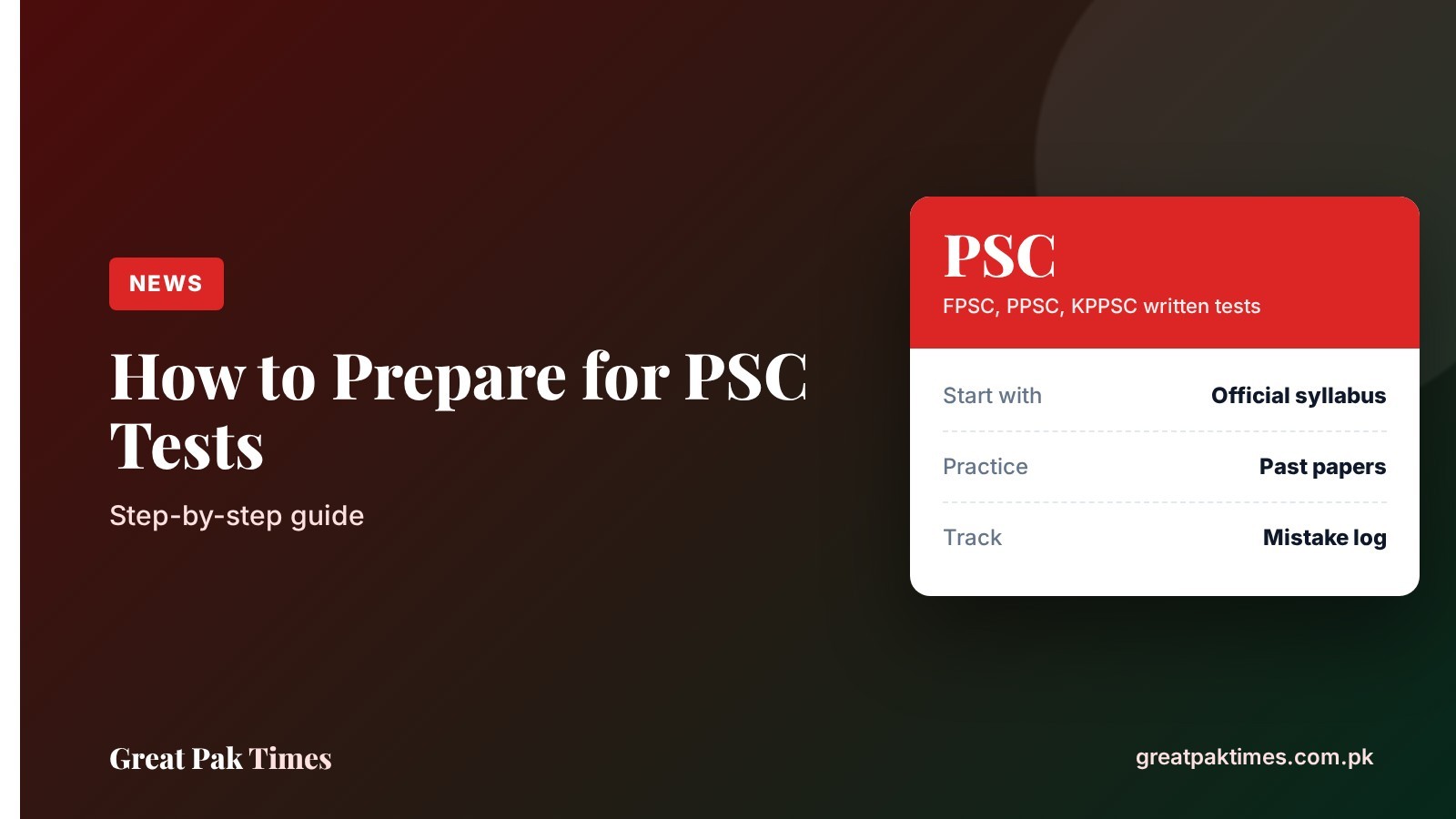
This guide shows how to prepare for a PSC written test in Pakistan, whether you are aiming for FPSC, PPSC, KPPSC or another public service commission. It is for first-time candidates who want a practical plan built on the official syllabus and past papers, not on guesswork or guaranteed shortcuts.
Before you start: what you need
- The advertisement for your exact post. Syllabus, eligibility and test details can differ from post to post.
- The official syllabus for that post. FPSC publishes syllabi for each consolidated advertisement on its GR Syllabus page (when we checked, it listed syllabi for Advertisement Nos. 01, 02 and 03 of 2026). KPPSC has a syllabus page with separate downloads for posts such as PMS, DSP, Sub Inspector, ASI and Civil Judge.
- Past papers. KPPSC lists past papers by year and post on its past papers page and also links a sample MCQs paper. FPSC’s Schedule menu has a Previous Question Papers section.
- A fixed study schedule, a notebook for mistakes, and a timer for practice papers.
How to prepare for a PSC written test: step by step
- Download the syllabus for your post. Use only the file from the commission’s website. Third-party syllabus lists are often for a different post or an older year.
- Break the syllabus into topics. Write each topic on a checklist, for example English, general knowledge, Pakistan studies, current affairs, Islamic studies, mathematics or your subject paper, whichever your syllabus lists. Tick topics off only after you have practised questions on them.
- Study the subject paper first if your post has one. Many specialist posts depend heavily on the discipline-related section, so give it the most time while still covering the general topics.
- Solve past papers early, not at the end. Attempt one past paper in the first week to see the question style. It shows you where you are weak and how the commission words its questions.
- Practise under time limits. Sit a full paper with a timer. If your test is computer based, practise reading and answering on a screen.
- Keep a mistake log. After every practice paper, write down each wrong answer, the correct answer and why you missed it. Revise this log weekly.
- Revise current affairs steadily. Read a reliable newspaper for a short time every day instead of cramming in the last week.
- Do a final revision week. Revise your checklist, your mistake log and one or two timed papers. Avoid starting new books now.
Test patterns, marking schemes and passing marks differ between commissions and posts, so follow the instructions in your own advertisement and roll number slip.
Before test day
- Get your admission certificate or call letter. FPSC posts admission certificates and time tables in the Schedule section of its website. KPPSC publishes CBT e-letters, which you can search by CNIC number.
- Read the commission’s notices to candidates. FPSC lists notices such as “Important Information for Candidates Appearing In General Recruitment Tests/ Exams” and “Observance of Standard Timings for All Exams of FPSC” on its home page. Read them in full before test day.
- Check the centre and timing. Visit the centre location a day earlier if you can, and plan to arrive well before reporting time.
After the written test
Results, shortlisting and merit lists are posted on the commission’s own website, so check it instead of relying on messages forwarded in groups. Some tests are screening tests with a passing threshold. For example, KPPSC lists an amendment to its function rules (July 2025) that sets a 50% passing threshold for the PMS screening test. Candidates who pass move on to the next stage, such as the written exam, psychological assessment or interview, depending on the post.
Common mistakes to avoid
- Studying from an unofficial syllabus. Always match your notes to the file on the commission’s website.
- Reading without practising. Reading a book twice helps less than solving one paper under time.
- Ignoring past papers. They show the style of questions the commission actually asks.
- Skipping official notices. Dates, centres and rules can change, and the commission’s website is the final word.
- Trusting paid “guaranteed pass” claims. No coaching centre or social media page can promise a result or a job.
Current openings and related posts
- How to apply for FPSC jobs online
- How to apply for PPSC jobs online
- How to apply for KPPSC jobs online
- BPS grades in Pakistan explained
- More openings in our Jobs section
Frequently asked questions
Where can I find the official syllabus for a PSC test?
On the commission’s website. FPSC has a Syllabus section for General Recruitment, and KPPSC has a Syllabus page with downloads for each post group. For other commissions, look in the same menu on their official site.
Are past papers available for PSC tests?
KPPSC publishes past papers for several posts and years, and FPSC has a Previous Question Papers section under Schedule. Availability depends on the post and year.
How many months should I prepare?
There is no official figure. It depends on the post, the syllabus size and your background. Start as soon as you see the syllabus, and keep your plan flexible once the test date is announced.
Note: Always confirm details on the official website before you apply or pay any fee. Great Pak Times is not affiliated with any government body.
Source: Federal Public Service Commission and Khyber Pakhtunkhwa Public Service Commission. Checked 7 November 2026.